
Satellite Communication Market Outlook 2030: Market Size, CAGR, Trends And Forecast Analysis
The Business Research Company’s Satellite Communication Global Market Report 2026 – Market Size, Trends, And Forecast
Press Release Disclaimer: This is a press release distributed through the XPR Media network. It has not been independently verified by our newsroom.

The Business Research Company’s Satellite Communication Global Market Report 2026 – Market Size, Trends, And Forecast 2026-2035
LONDON, GREATER LONDON , UNITED KINGDOM, October 28, 2026 /EINPresswire.com/ — The satellite communication market is undergoing significant transformation as advancements in satellite technology and increasing demand for global connectivity shape its future. With growing investments and expanding applications across various industries, the landscape is set to evolve rapidly over the coming years. Let’s delve into the market’s size, key growth drivers, leading players, and emerging trends that are defining this dynamic sector.
Projected Size and Growth Trajectory of the Satellite Communication Market
By 2030, transponders are expected to dominate the satellite communication market, representing 33 percent or $37 billion of the total revenue. This rise is fueled by the expansion of high-throughput satellites and the growing need for broadcasting and data transmission. Major global satellite operators, communication service providers, and aerospace technology firms are actively competing by developing advanced satellite networks, boosting throughput capabilities, and enhancing ground infrastructure. Central to their strategies are broadband coverage improvements, deployment of low Earth orbit (LEO) satellites, network integration, and expanded digital connectivity.
Request A Free Sample Of The Satellite Communication Market Report
https://thebusinessresearchcompany.com/sample_request?id=50054784&type=smp&name=Satellite%20Communication%20Market%20Report%202026&utm_source=EINPresswire&utm_medium=Paid&utm_campaign=Oct_PR
Satellite Communication Market Set to Reach $113 Billion with Rapid Growth
Forecasts indicate that the satellite communication market will surpass $113 billion by 2030, growing at a compound annual growth rate (CAGR) of 11 percent. This segment forms roughly 9 percent of its parent Wireless Telecommunication Carriers market, which is projected to reach about $1,201 billion in the same year. Within the broader Information Technology sector, valued at $13,788 billion by 2030, satellite communication will account for nearly 0.8 percent of the total market value.
Asia-Pacific Emerges as the Fastest Growing and Largest Regional Market
Asia-Pacific is expected to lead the satellite communication market in 2030 with an estimated value of $37 billion, up from $20 billion in 2025, reflecting a robust 13 percent CAGR. This rapid growth is driven by intensified satellite programs by regional space agencies, increased demand for broadband services in remote and underserved areas, and heightened requirements for defense and maritime communications. Investments in satellite-enabled disaster management, environmental monitoring, commercial launches, and expanding applications in aviation, energy, and transportation sectors across countries such as China, India, Japan, Australia, and Southeast Asia further contribute to this upward trajectory.
Access The Detailed Satellite Communication Market Report Here
https://thebusinessresearchcompany.com/report/satellite-communication-global-market-report?utm_source=EINPresswire&utm_medium=Paid&utm_campaign=Oct_PR
The United States Maintains a Significant Share Amidst Continued Growth
In 2030, the United States is projected to hold the largest national market at $30 billion, rising from $18 billion in 2025 at an 11 percent CAGR. This growth is backed by investments in next-generation satellite constellations, defense and homeland security communications, commercialization efforts within the space sector, and private satellite ventures. Additionally, increasing demand for in-flight and maritime connectivity, advancements in satellite manufacturing, and nationwide deployment of satellite broadband will support this expansion.
LEO Constellations Fuel Market Expansion
One of the primary drivers of growth in satellite communication is the increasing deployment of Low Earth Orbit (LEO) satellite constellations. These commercial constellations provide high-speed, low-latency connectivity suitable for broadband, enterprise, and mobile applications. Investment in these networks is stimulating demand for transponders, antennas, and ground infrastructure. Continuous satellite launches and enhanced coverage for underserved regions are expected to sustain long-term market growth, contributing an estimated 2.9 percent annual increase.
Expanding Broadband Access in Remote Locations Spurs Demand
Demand for broadband connectivity in rural and underserved areas is also accelerating market growth. Governments and telecom providers are extending satellite broadband services where terrestrial networks are not economically viable, supporting critical sectors like education, healthcare, emergency response, and e-government services. Remote industrial sites such as mining, oil, gas, and energy sectors increasingly depend on satellite links for communication, driving an anticipated 2.7 percent annual growth in the market.
Defense and National Security Investments Strengthen Market Momentum
Increased defense and national security budgets worldwide are further propelling growth in the satellite communication market. Militaries require secure, encrypted, and resilient communication systems for command, control, intelligence, surveillance, and tactical operations across multiple domains. Fleet modernization and ground infrastructure upgrades amid geopolitical tensions are raising demand for advanced satellite components, contributing about 2.2 percent to annual market growth.
Key Component Segments Drive Over $45 Billion Market Expansion
The market segments including transponders, transceivers, antennas, receivers, and other components represent significant growth opportunities, collectively adding more than $45 billion by 2030. Transponders alone are expected to increase by $14 billion, antennas by $13 billion, transceivers by $10 billion, receivers by $5 billion, and other components by $3 billion between 2025 and 2030. This growth is supported by LEO constellation deployments, demand for high-capacity payloads, adoption of electronically steered and phased-array antennas, innovations in signal processing and frequency management, investments in next-generation ground stations, and the integration of satellite systems with 5G and non-terrestrial network architectures. These developments highlight the industry’s focus on achieving seamless global connectivity and resilient communications.
The Dominance of Transponders in Market Composition
When broken down by component, transponders are set to be the largest segment in 2030, accounting for a third of total market revenue. Their growth is driven by the deployment of high-throughput satellites that provide increased bandwidth, growing satellite broadcasting and data transmission needs, multi-band frequency applications, and investments in both geostationary and non-geostationary satellite systems. Improvements in transponder efficiency, signal processing, and spectrum utilization further support this segment’s expansion.
Diverse Segmentation by Technology, Application, and Industry Verticals
The satellite communication market is segmented technologically into SATCOM automatic identification systems, SATCOM VSAT, SATCOM on-the-move (SOTM), SATCOM on-the-pause (SOTP), and SATCOM telemetry. Applications include asset tracking and monitoring, airtime services, data backup and recovery, navigation and monitoring, broadcasting, drone connectivity, telemedicine, and others. Vertically, the market serves government and military sectors, civil satellite communications, commercial applications, and additional industry verticals.
The Rise of Heavy Naval Communication Satellites Shapes Market Direction
Advanced communication satellites with increased payload capacities and secure connectivity are reshaping the market. For example, in November 2025, the Indian Space Research Organisation launched CMS-03 (GSAT-7R), the country’s heaviest indigenously built communication satellite. Designed to support secure naval communications, it offers multi-band capabilities, encrypted links, and an extended mission lifespan, enhancing maritime operations, real-time coordination, and network-centric defense capabilities.
Fragmentation and Competitive Landscape of the Satellite Communication Market
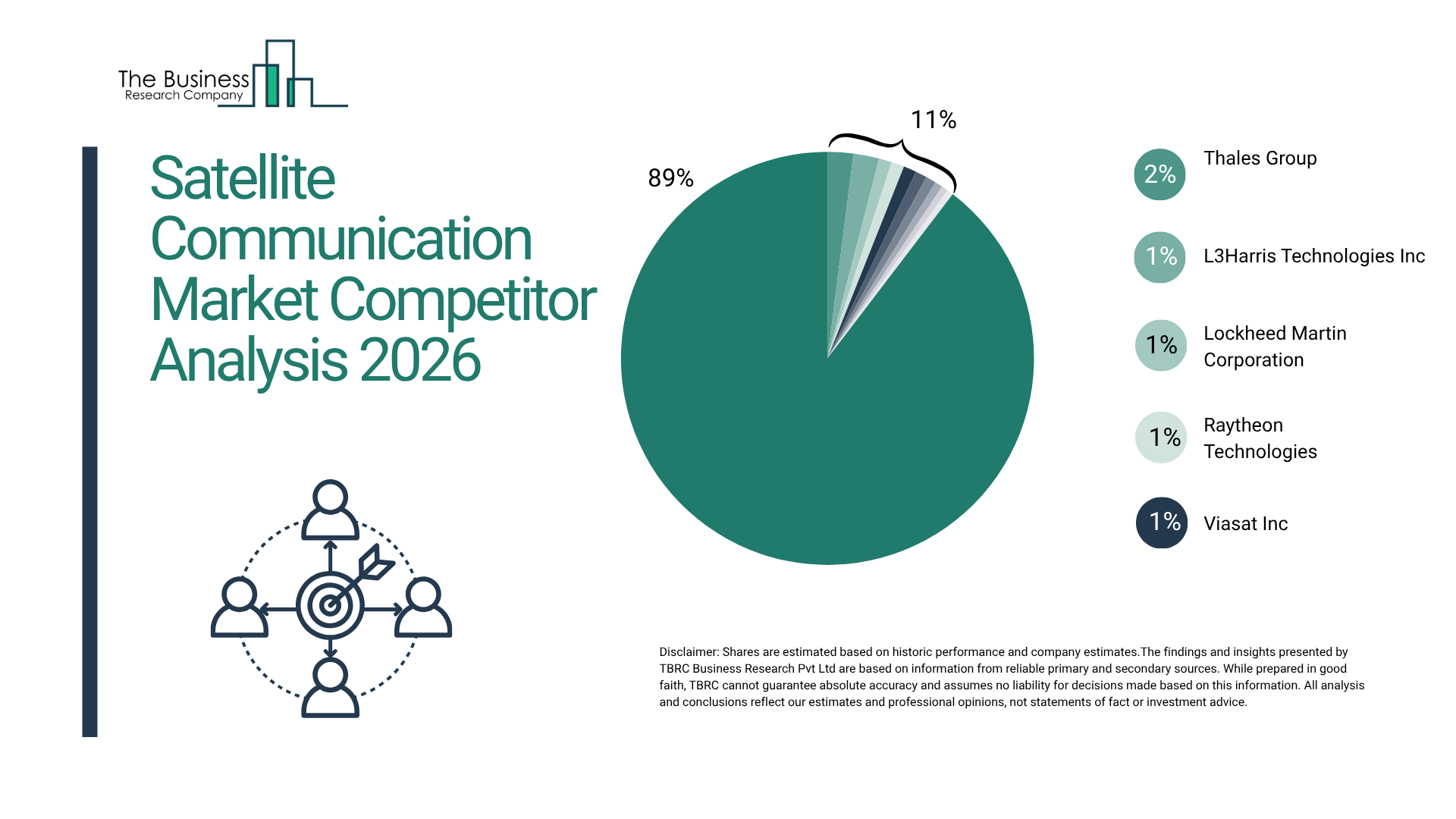
The satellite communication market remains fairly fragmented, with the top ten companies accounting for only 11 percent of total revenue in 2025. Moderate barriers to entry exist due to complex satellite design, spectrum allocation, high capital requirements, and the need for reliability in mission-critical connectivity. Leading firms maintain their market shares through diverse portfolios, strong aerospace and defense partnerships, global satellite networks, and continuous innovation. As the demand for satellite broadband, secure communications, and next-generation connectivity grows, collaboration, technological advancements, and geographic expansion will be key competitive strategies.
Market Share Leaders Among Satellite Communication Companies
In 2025, Thales Group led global sales with a 2 percent market share, followed by L3Harris Technologies Inc at 2 percent, Lockheed Martin Corporation at 1 percent, Raytheon Technologies at 1 percent, Viasat Inc at 1 percent, and several others each holding about 1 percent or less of the market.
Strategic Approaches Employed by Industry Leaders
Top companies are focusing on building next-generation satellite networks to enhance global connectivity, improving data transmission and accessibility, expanding satellite infrastructure to support broadband and remote access, and integrating artificial intelligence technologies to optimize network efficiency and performance.
Thales Group’s Leadership in Secure Satellite Connectivity
Thales Group’s aerospace and defense communication division leads the market by providing satellite communication systems, secure connectivity solutions, ground infrastructure, and network technologies. Their offerings cater to government, defense, commercial, and civil sectors, securing their position as the largest player in satellite communications worldwide.
Comprehensive List of Major Satellite Communication Market Participants
The market includes prominent companies such as Thales Group, L3Harris Technologies Inc, Lockheed Martin Corporation, Raytheon Technologies, Viasat Inc, EchoStar Corporation, Honeywell International Inc, General Dynamics, China Satellite Communications Co Ltd, Intelsat Solutions, Iridium Communications Inc, Telesat, Gilat Satellite Networks Ltd, Spire Global Inc., Al Yah Satellite Communication Company PJSC (Yahsat), Hughes Communications India Ltd., Telespazio SpA, Jio Satellite Communications Ltd, JSC Information Satellite Systems Reshetnev, TerreStar Solutions Inc, Andesat SA, KVH Industries Inc., Russian Satellite Communications Company, and Ciel Satellite Group.
From Manufacturers to End Users: The Satellite Communication Market Ecosystem
Key raw material suppliers include Thales Alenia Space, Airbus Defence and Space, Lockheed Martin Corporation, Northrop Grumman Corporation, Boeing Satellite Systems, L3Harris Technologies Inc., RTX Corporation, Honeywell International Inc., Leonardo S.p.A., Mitsubishi Electric Corporation, NEC Corporation, Rohde & Schwarz GmbH & Co. KG, Cobham Limited, Teledyne Technologies Incorporated, Qorvo Inc., Analog Devices Inc., Texas Instruments Incorporated, Infineon Technologies AG, NXP Semiconductors N.V., STMicroelectronics N.V., Broadcom Inc., Qualcomm Incorporated, Viasat Inc., Gilat Satellite Networks Ltd., and Kratos Defense & Security Solutions Inc.
Leading wholesalers and distributors servicing the market include Arrow Electronics Inc., Avnet Inc., Digi-Key Electronics, Mouser Electronics, Future Electronics Inc., TTI Inc., RS Group plc, Farnell Global, Newark Electronics, Allied Electronics & Automation, Rutronik Elektronische Bauelemente GmbH, WPG Holdings Limited, Macnica Inc., Marubeni Information Systems Co. Ltd., Ingram Micro Inc., Tech Data Corporation, ScanSource Inc., Synnex Corporation, Bechtle AG, ALSO Holding AG, Esprinet S.p.A., EET Group A/S, Redington Limited, Mindware FZ LLC, and ASBIS Enterprises PLC.
Prominent end users encompass SES S.A., Intelsat S.A., Eutelsat Group, Telesat Corporation, EchoStar Corporation, Iridium Communications Inc., Globalstar Inc., OneWeb Network Access Associates Limited, SpaceX Starlink, China Satellite Communications Corporation, Singapore Telecommunications Limited, NTT Communications Corporation, KDDI Corporation, Verizon Communications Inc., AT&T Inc., BT Group plc, Orange S.A., Deutsche Telekom AG, Telefónica S.A., Vodafone Group plc, Inmarsat Global Limited, Arabsat, Asia Satellite Telecommunications Company Limited, Hispasat S.A., and Thaicom Public Company Limited.
New analytical features added to our 2026 market reports:
• Market attractiveness scoring and analysis
• Total addressable market (TAM) analysis
• Company scoring matrix graphics and tables
• Excel-based forecasting dashboards
• Market hotspots infographics
• Key technologies and future trend analysis
• Updated graphics and tables
Learn More About The Business Research Company
The Business Research Company (www.thebusinessresearchcompany.com) is a leading market intelligence firm renowned for its expertise in company, market, and consumer research. We have published over 30,000+ reports across 27 industries and 60+ geographies. Our research is powered by 1,500,000 datasets, extensive secondary research, and exclusive insights from interviews with industry leaders.
We provide continuous and custom research services, offering a range of specialized packages tailored to your needs, including Market Entry Research Package, Competitor Tracking Package, Supplier & Distributor Package and much more.
Disclaimer: Please note that the findings, conclusions and recommendations that TBRC Business Research Pvt Ltd delivers are based on information gathered in good faith from both primary and secondary sources, whose accuracy we are not always in a position to guarantee. As such TBRC Business Research Pvt Ltd can accept no liability whatever for actions taken based on any information that may subsequently prove to be incorrect. Analysis and findings included in TBRC reports and presentations are our estimates, opinions and are not intended as statements of fact or investment guidance.
Contact Us:
The Business Research Company
Americas +1 310-496-7795
Europe +44 7882 955267
Asia & Others +44 7882 955267 & +91 8897263534
Email: marketing@tbrc.info
Follow Us On:
LinkedIn: https://in.linkedin.com/company/the-business-research-company.
Oliver Guirdham
The Business Research Company
+44 7882 955267
info@tbrc.info
Visit us on social media:
LinkedIn
Facebook
X
Legal Disclaimer:
EIN Presswire provides this news content “as is” without warranty of any kind. We do not accept any responsibility or liability
for the accuracy, content, images, videos, licenses, completeness, legality, or reliability of the information contained in this
article. If you have any complaints or copyright issues related to this article, kindly contact the author above.

Media gallery
